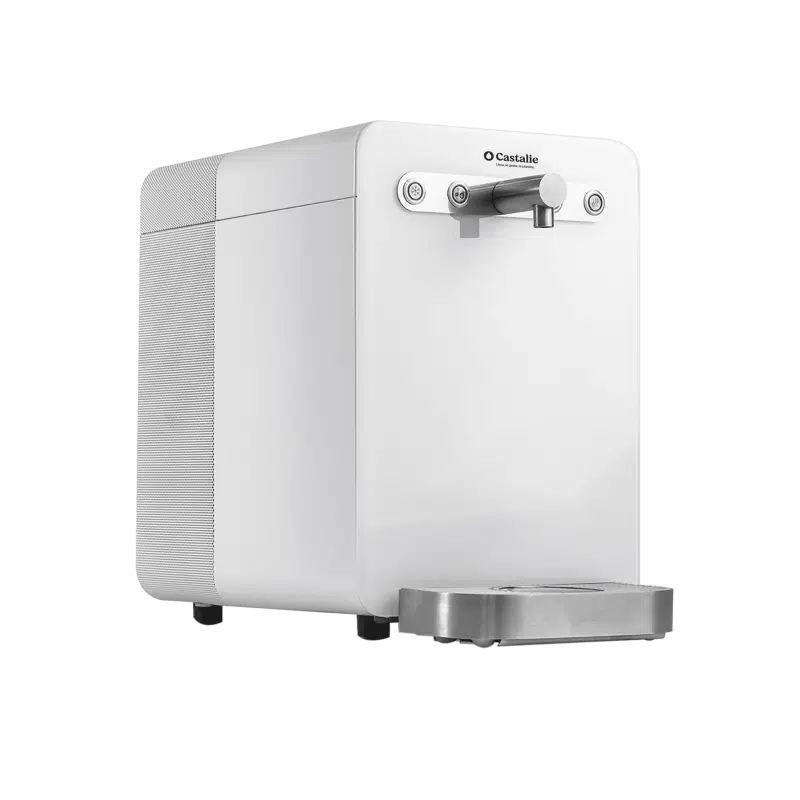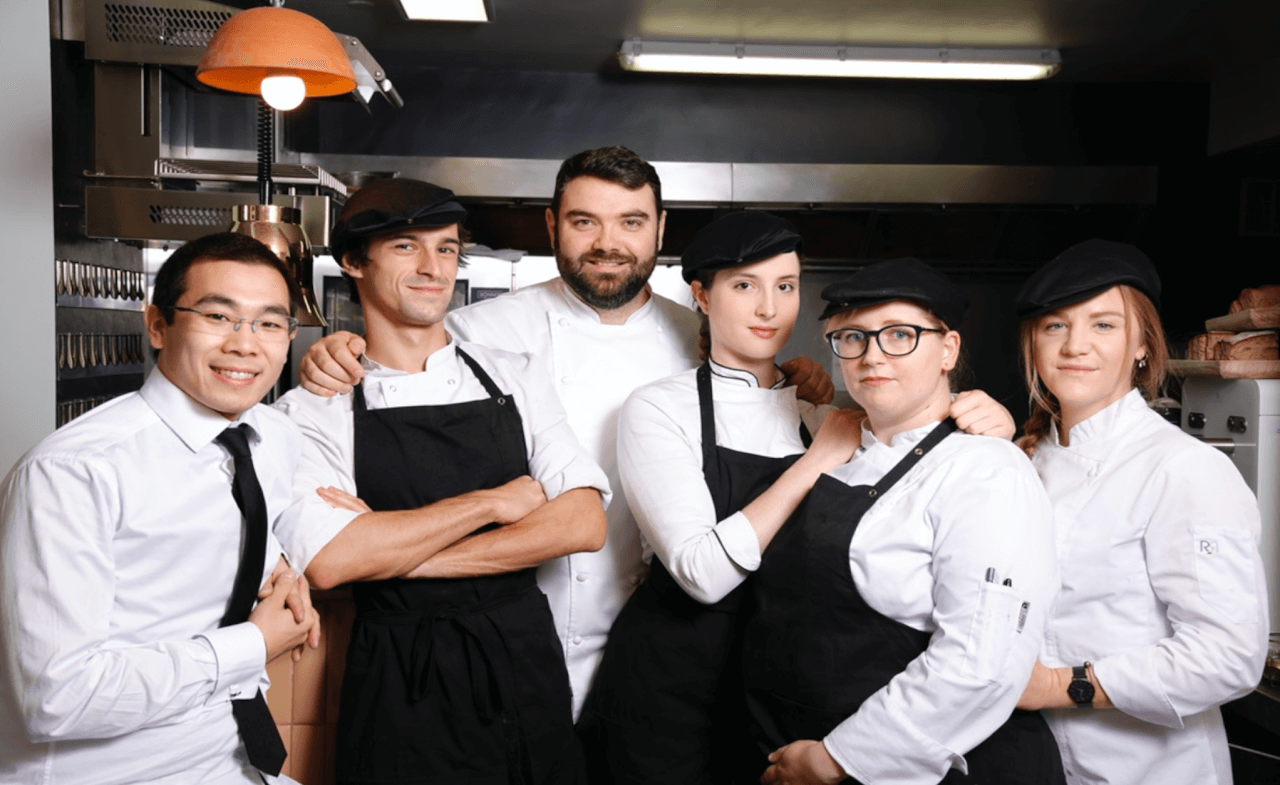
One of the most eco-friendly restaurants in Paris, La Table de Colette is an example to follow. Low-carbon cuisine, products sourced from ultra-short supply chains, sustainable fishing and farming practices that respect the environment and biodiversity: Josselin Marie is constantly striving to minimize his ecological footprint. Supported by CASTALIE the beginning of his adventure, the chef shares his convictions and his connection with CASTALIE.
How did you hear about our brand?
The first time I drank CASTALIE was at one of my chef friends' houses, when I went there for lunch and found it to be really good. I met Thibault Lamarque through Jean Luc Fessard (President of the Bon pour le Climat association). It was obvious to me that I needed to find an eco-friendly water solution. I didn't even bother to find out if there were any competitors; choosing CASTALIE was a no-brainer.
Why did you choose CASTALIE
I chose CASTALIE the bottle design is very appealing, the water quality is excellent, and finally because it truly meets the environmental and ecological criteria I was looking for. At La table de Colette, two things are inseparable: environmental considerations and taste. If it's eco-friendly but doesn't taste good, or vice versa, it's not for us. We want both.
What is the volume of CASTALIE water bottles CASTALIE per month?
It's huge. Our turnover is booming, we've quadrupled it in six months, so it's hard to get some perspective, but with around 35 covers, like last night, we served around 30 bottles, which is just under half a bottle per person. We do offer two brands of mineral water, but to be honest, since we opened, we've only sold three bottles.
We also use microfiltered water for cooking! We realized that when we make meat juice, cook vegetables, or add liquid to soup with CASTALIE water, the vegetables stand out more clearly. Today, if I'm presented with a butternut squash soup made with CASTALIE water CASTALIE a soup made with tap water, I can immediately tell the difference! It's clearer, without the chlorine that can be found in tap water. It's cleaner, with a more accurate and balanced flavor. With meat juices, you can really tell the difference because the main ingredient is water, and with microfiltered water, the meat juice tastes much better.
How does the CASTALIE solution CASTALIE your business challenges?
With CASTALIE, we don't generate revenue because we don't sell it, we offer it. I think customers would find it very difficult to understand why we don't offer them a bottle of microfiltered water. We offer it, and it's a big hit with customers. In the medium term, when it comes to managing orders and deliveries, there's no contest. It saves me almost one person! Vincent is alone in the dining room and already overwhelmed. If I added water delivery management to his responsibilities, it would be impossible. I've seen this so many times when I worked in other restaurants, where five of us would spend more than 15 minutes dealing with deliveries. It's nonsense, it's too complicated. I'm not going back to the old way, that's for sure.
How did your team perceive this water solution?
We decided to give our staff CASTALIE water CASTALIE naturally they drink as much as they want. They also started using it in the kitchen, and the quality of the food has improved as a result. We are really happy to have a water cooler.
Would you recommend CASTALIE
Yes, I talk about it regularly! When my chef friends tell me, "You're crazy to give it away," I disagree. Giving away something that doesn't pollute is part of being eco-friendly. It makes sense and fits in with our approach! It's more logical to charge for what pollutes than the other way around. That said, I don't mind at all charging €2 or €3 per bottle to make the water cooler profitable. But from an environmental standpoint, that's what needs to be done. In my opinion, action should be taken at the state level to impose an additional tax on water bottles because they have to be transported, delivered, etc. The CRAMIF offers subsidies, so I don't understand why they don't offer a refund or cover the cost of the CASTALIE water cooler. In terms of workplace accidents, storing water bottles and carrying heavy items can cause back pain after 20 years, whereas with a water cooler, there's no such problem!
Is it important to you to develop a responsible and environmentally friendly approach?
Yes, clearly it was very important! About five years ago, I became aware of environmental issues after watching two documentaries, Davis Guggenheim's An Inconvenient Truth and Mélanie Laurent and Cyril Dion's film Tomorrow. When I watched these two films, I realized that food was responsible for one-third of climate change. It was a subject that affected me, but I didn't know how to take action. When I realized that my job was largely responsible for global warming, I told myself that we couldn't just stand by and do nothing.
So I started to do some research and presented a project to the management of the hotel where I was working, but they didn't believe in my project. So I persisted because I knew there was something that could be done, and I continued with my plan. A short time later, we hired an apprentice who wanted to write his end-of-year thesis on "What is an eco-friendly restaurant?" I told him, "Let's do it, let's go for it." He got a 19/20 and introduced me, through his school, to Jean Luc Fessard, who showed me his eco-calculator. It was part of one of the solutions we could implement: the choice of ingredients we put on the plate is very important, and the chef can influence that. So we started cooking low-carbon meals without really talking about it. We realized that customers were starting to be receptive. In the end, we created a whole world on the plate, a real identity.
But how could we go further? So we discovered lots of other exciting topics: CASTALIE, green energy, low-energy cooking, sorting all waste, a low-carbon menu... At La table de Colette, we do everything! We use renewable energy, we have a low-energy kitchen with state-of-the-art equipment, we recover our bio-waste, we sort all our waste, we've created a menu so that there are no leftovers at the end of the week, we calculate the carbon footprint of our dishes, and before the restaurant opened, we wanted to offset the carbon impact of its construction by working with Ecotree, which is reforesting in Brittany and elsewhere in France.
What other measures are you implementing in your restaurant, apart from those you have already mentioned?
There are many others, it's impossible to list them all, but for example:
- We work with Valrhona to advise them on eco-friendly chocolate. We also advised METRO on a whole manual on La table de Colette using only METRO ingredients.
- At the restaurant, we make our own bread using flour from Philippe Guichard (this producer works with INRA to preserve ancient wheat varieties, which contain 15 times less gluten than modern wheat).
- We offer only high-end biodynamic and organic wines (the head sommelier at Les Climats and former sommelier at Taillevent worked with us to create an eco-friendly wine list).
- When it comes to tableware, cutlery, plates, and glasses, everything comes from a zero-carbon, zero-waste factory in Germany.
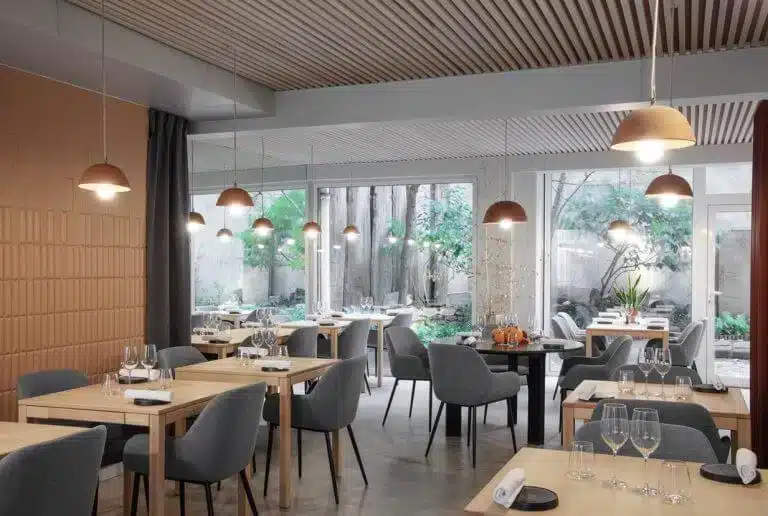
- The restaurant tables are made of certified beech wood: the wood is grown as it should be. The chairs on the terrace are recycled.
I could talk about it for hours, but everything has been carefully thought out and worked on, from the light bulb to the ceiling! We have really tried to work on the entire value chain. It's an ongoing process, and I'm constantly thinking about new initiatives.
What actions for the planet would you like to implement in the future?
Colette's Table is a gourmet restaurant, and I would like to open an eco-friendly bistro that is profitable. Once the concept has been developed and finalized, why not replicate it in Paris or elsewhere!
Interview conducted by Anne-Laure Brouillat & Jeanne Favas
Credits: La Table de Colette