Adopted on February 10, 2020, and published in the Official Journal on February 11, 2020, the anti-waste law for a circular economy is a continuation of the 2004 Environmental Charter. Its objective is to accelerate the momentum for preserving natural resources and protecting the climate and biodiversity. Here are the four main measures to know about the circular economy law.
Aiming for zero disposable plastic by 2040
The environmental impact of plastic is well established. To address this issue, the law on combating resource waste aims to achieve zero disposable plastic by 2040.
To achieve this, the law provides for a gradual phase-out of disposable plastic, with a new step each year towards ending the market for single-use plastic packaging. Set by decree, the annual targets for reduction, reuse, recycling, and repurposing provide greater clarity.
The objectives are divided into four distinct periods, in five-year increments, as part of an ecological transition. Between 2020 and 2025, the goal is to reduce single-use plastic packaging by 20% through reuse and smart recycling to reduce loss and waste.
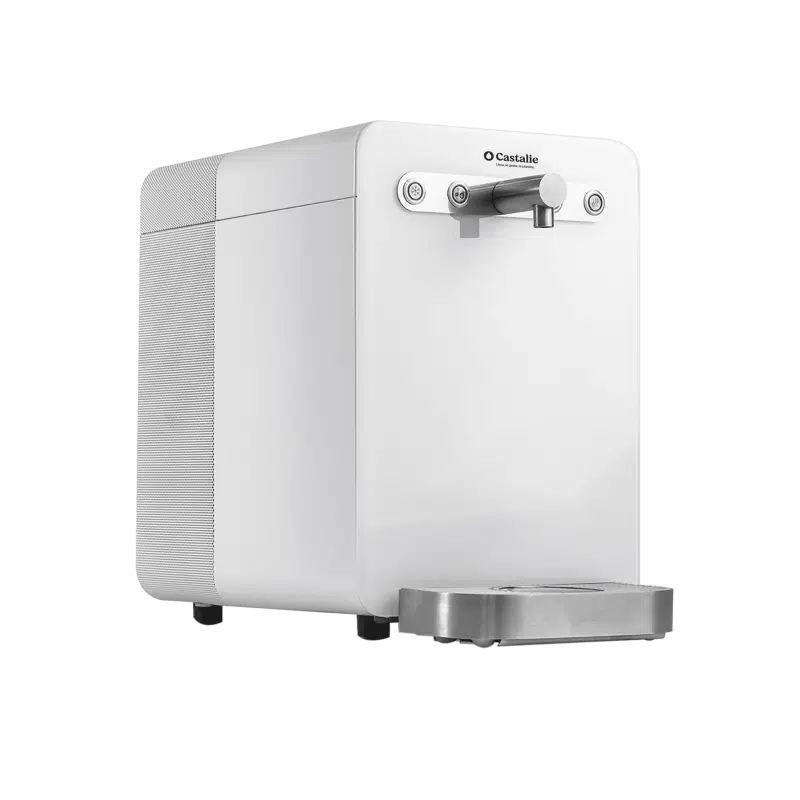
It should be noted that since January 1, 2021, establishments open to the public and business premises (particularly canteens) are no longer allowed to distribute free plastic bottles. Similarly, all establishments open to the public must have at least one drinking water fountain with free access as of January 1, 2022.
2025 Update: For a comprehensive overview of the latest regulations, check out our special report on the AGEC Act and responsible water solutions.

Better consumer information for responsible consumption
Today, many consumers lack information about waste sorting and recycling. However, the recovery of unconsumed food has a real environmental impact.
The law aims to bring about a transition to a more responsible economy through measures designed to facilitate sorting. All products must feature a unique logo indicating where they should be disposed of and whether they can be sorted. Consumers must also be informed about sorting procedures (drop-off at supermarkets for electrical and electronic equipment, collection points, sorting in yellow bins for cardboard, etc.).
There are also plans to standardize the color of trash cans throughout France to help everyone recycle consumables more effectively and contribute to their new life cycle in an anti-waste economic system. Similarly, starting January 1, 2022, manufacturers will be required to inform consumers about the presence of endocrine disruptors in their products.
Fighting food waste and recycling waste
Today, reusing unsold goods from supermarkets and other waste from human consumption is an environmental issue. This is especially true when we consider that tons of food, fruit, and vegetables are thrown away every day, representing a significant loss of food.
To prevent food waste, the law promotes social and solidarity-based reuse in line with industrial ecology principles. The aim is to improve resource consumption and contribute to green growth. The anti-waste social economy law puts an end to the disposal of unsold non-food items. A world first, this measure applies to all manufacturers, who will be required to donate unsold items to associations fighting poverty and other charitable organizations in the solidarity economy. Recycling is strongly encouraged in all cases, and those who fail to comply with this obligation will incur a higher fine.
Similarly, the law requires catering and food distribution to halve food waste by 2025, compared to 2015. Finally, reuse is encouraged and the government is proposing specific measures to support companies and startups in their efforts to combat food waste.

Creation of new polluter-pays schemes
The zero waste law aims to extend the responsibility of industries in waste management. To achieve this goal, it introduces new polluter-pays schemes. These manufacturers must therefore contribute to financing the end-of-life management of tons of products that are usually thrown away.
This new model contributes to the drive to reduce waste and make better use of resources, as part of the energy and ecological transition we are currently seeing. The law provides for the creation of 11 new sectors, including toys, leisure and DIY items (from January 1, 2022) and single-use textiles.
The scope of the fight against food waste for the environment now also extends to commercial packaging, which is now recycled. The extension applies to all catering professionals since January 1, 2021, and will be extended to all commercial packaging from January 1, 2025.
The polluter pays system now involves a more severe penalty regime for eco-organizations. Each producer required to comply with the polluter pays system must draw up a roadmap every five years for the eco-design of its products. The action plan is then refined.
Text: Laetitia Maroussie