On January 1, 2023, the ban on disposable tableware in fast-food restaurants caused quite a stir. But this is not the only ban affecting the hotel and restaurant industry.
The Anti-Waste Law for a Circular Economy (AGEC) aims to change our consumption model to make it more virtuous, focused on reducing waste and preserving biodiversity. The ultimate goal is to end the use of single-use plastic packaging by 2040.
Since February 10, 2022, hotels, restaurants, and all establishments open to the public (ERP) are required to provide water fountains accessible to their visitors and employees and are prohibited from distributing plastic water bottles.
Based on the number of customers, visitors, and employees, the requirement for water fountain equipment is set at one fountain per 300 people. They must be clearly marked and provide free drinking water, in addition to being connected to the mains water supply.
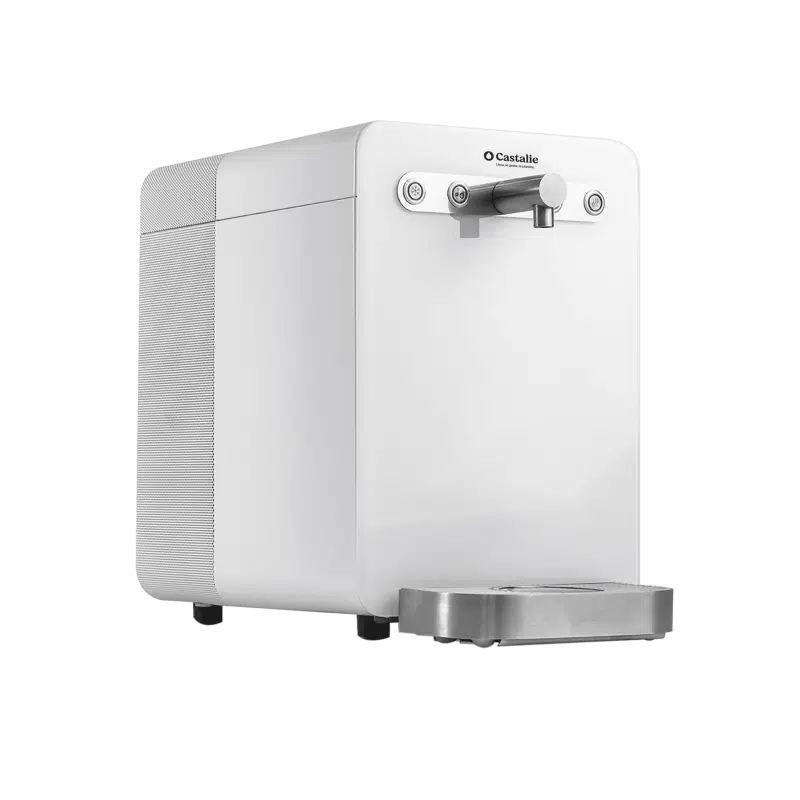
These fountains have a huge advantage over bottled water fountains, as they do not require any logistics in terms of storage or supply. What's more, they are often much more stylish than their refillable counterparts.
Which public buildings are affected by the law?
The obligation applies to three categories of establishments:
- Category 1 covers all structures that can accommodate more than 1,500 people, such as government buildings, amusement parks, and theaters.
- Category 2 includes all establishments with 701 to 1,500 people, such as schools, museums, and medium-sized shopping centers.
- Category 3 includes all establishments that can accommodate 301 to 700 people, such ashotels, spas, and certain vacation centers.
The Agec law aims to eliminate all single-use plastics by 2040, but the first measures date back to before the law was enacted. In 2016, the Energy Transition and Green Growth Act banned plastic plates and cups from supermarket shelves. In 2018, the Egalim Act continued along the same path by eliminating single-use water bottles from school cafeterias.
At the beginning of 2021, this time with the Agec law, expanded polystyrene packaging (such as kebab boxes) disappeared, followed by small plastic utensils such as steak picks, stirrers, and straws.
In 2022, the AGEC law tackled the overpackaging of fresh fruit and vegetables, then plastic toys available in children's menus at many large fast-food chains.
Hotels, cafes, restaurants: what you need to adopt from January 1, 2023
- The obligation to use reusable tableware. At the beginning of 2023, the AGEC law aims to eliminate single-use tableware from the restaurant sector. As of January 1, 2023, restaurants are required to serve meals eaten on the premises in reusable tableware, which includes cups and lids as well as plates and cutlery.
- The end of automatic receipts
Not sure what to do with your receipts? From now on, printing them will no longer be mandatory and must be clearly requested by the customer. This measure applies to receipts and credit card slips issued at the end of your purchases. - Recycling bio-waste
Catering establishments are required to process their bio-waste (kitchen waste, green waste, dishwashing waste). With the enactment of the AGEC law, this requirement has been reduced to 5 tons/year, which is equivalent to around 100 meals per day in commercial catering.
While the hospitality sector has its own unique characteristics, offices and corporate headquarters are also subject to strict regulations. Learn how to comply with the AGEC law regarding drinking water in the workplace in your commercial spaces.
And in the future...
Among the measures already announced for the coming years are a ban on the sale of medical devices containing microplastics as of January 1, 2024, a requirement for new washing machines to be equipped with plastic microfiber filters as of January 1, 2025, and a ban on the sale of rinse-off cosmetic products containing microplastics, such as shampoos, soaps, or makeup removers, as of January 1, 2026.
If these measures are properly implemented, they should enable us to phase out single-use plastic packaging by 2040. This is a real step forward that needs to be taken urgently, and it will only be possible if we all work together. You know what you have to do!
And how does CASTALIE support CASTALIE in all this?
The AGEC law and CASTALIE water coolers CASTALIE an opportunity for establishments open to the public to offer high-quality water that reflects their image and enriches the experience offered to their guests, users, or customers. Our water coolers are an excellent response to the objectives set out in the AGEC law.
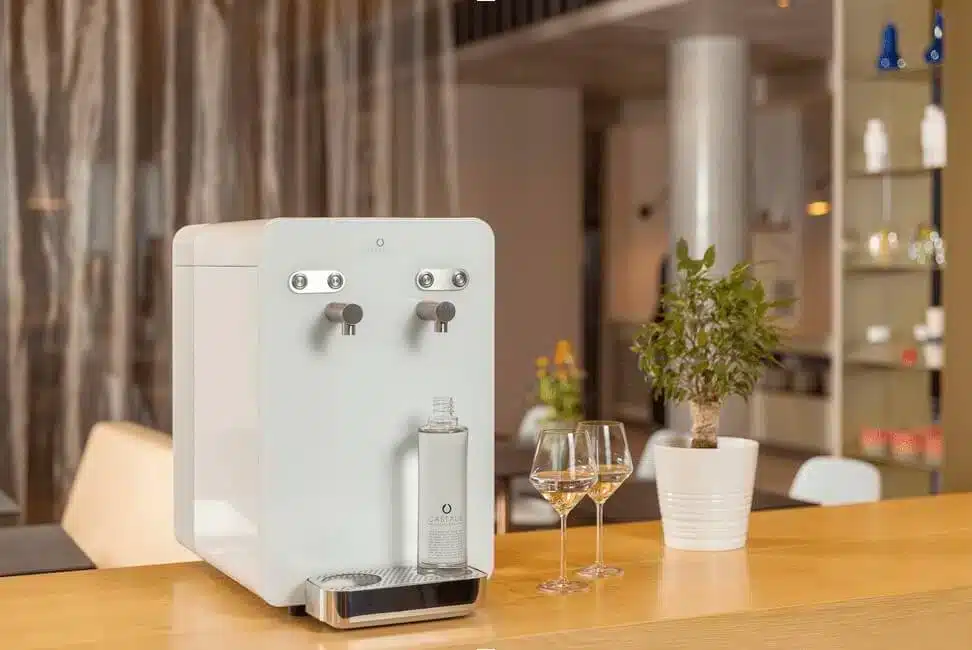
Our fountains are made of glass and steel. Their white color and sleek design allow them to fit perfectly into your establishment with elegance.
CASTALIE water coolers CASTALIE connected to the mains water supply, providing high-quality water directly at the tap. But we know how problematic the taste of water can be. That's why all our water coolers are designed with a set of ACS (Attestation de Conformité Sanitaire) certified filters that reduce chlorine, rare particles, and residues to provide CASTALIE water CASTALIE a neutral taste.
A solution tailored to the requirements of the AGEC law
Thanks to the CASTALIE water fountain, equipped public buildings offer a solution that complies with the requirements of the AGEC law and demonstrate their commitment to reducing plastic use.
We would be delighted to assist you with your water fountain equipment project.