If you are interested in design, ecology, or both, you have probably heard of eco-design, without necessarily knowing what these terms mean. Because these concepts are set to become increasingly common and represent a real challenge in reducing the environmental impact of our goods and services, here is an article that will give you a better understanding of what an eco-designed object actually is. We promise, after reading this, you'll be an expert!
Eco-design and eco-design: what are the differences? 🌱
While eco-design and eco-planning stem from the same philosophy, namely reducing the environmental impact of a product or service throughout its entire life cycle, they differ in their scope of application.
Eco-design
It covers the development and manufacture of a product, whereas eco-design concerns the aesthetic and functional aspects of that product.
Thus, in the case of a table, for example, eco-design concerns the choice of raw materials, the manufacturing method, the packaging, and the recycling of the product.
Eco-design
This concerns the appearance of the table: can it be both eco-friendly and practical to use, environmentally friendly and aesthetically pleasing?
Eco-design and eco-conception are two closely related concepts: an eco-designed object that does not meet the consumer's aesthetic requirements will not be used and will have been produced for nothing. The opposite of what we are looking for!
How to eco-design a product? ♻️
To develop and manufacture an environmentally friendly product or service, there are several criteria to consider.
Raw materials
The base. These must be as easily recyclable as possible and come mainly from renewable raw materials of plant or animal origin in order to limit their environmental impact. They must therefore be chosen on the basis of both their low ecological impact and their durability, so that the finished product has the longest possible lifespan . For the furniture brand Cassina, for example, the famous designer Philippe Starck chose in 2019 to design sofas made of leather... from apples!
Manufacturing and transportation processes
This is an important criterion to consider. The product must, of course, pollute as little as possible and minimize CO2 and other greenhouse gas emissions. An eco-designed product will therefore, as far as possible, be produced locally and in an environmentally friendly manner.
Product packaging
" Eco-packaging," " eco-friendly packaging," or even " eco-design packaging ": it seems obvious from an outside perspective, but it's not that simple to implement. Packaging techniques and materials are often chosen for their price and efficiency. It can sometimes be very time-consuming and difficult to adopt an alternative that protects the product properly! The CASTALIE teams CASTALIE in discussions with those at the French industrial group SEB this summer to share best practices.
Here are some of their areas of focus:
- reduce polystyrene (EPS) and plastic sub-packaging through various alternatives currently being studied (molded cellulose, cardboard, honeycomb, tissue paper sheets, reusable fabric bags, etc.)
- reduce empty space in packaging and transport
- promote 100% recyclable materials
- avoid excessive packaging
- opt for vegetable-based or water-based inks
- promote FSC-certified materials and materials made from recycled fibers
- And, of course, raising consumer awareness about reusing and recycling packaging, because one cannot happen without the other!
Strong and inspiring commitments that motivate us to get involved in this endeavor too!
End of product life
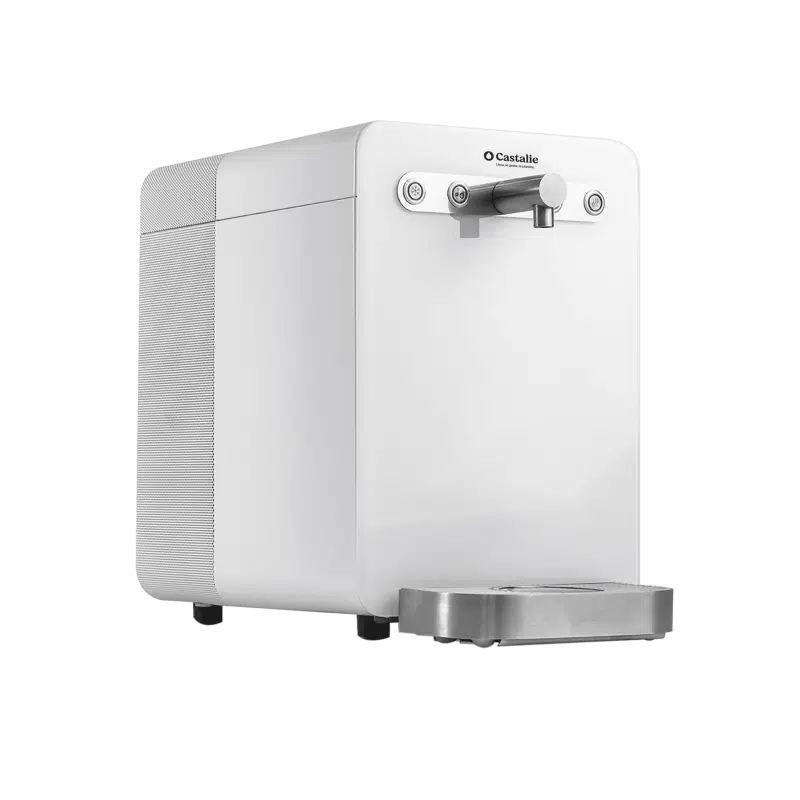
It is an integral part of eco-design: even before it is created, the object must be designed in such a way that it can be easily reused, repaired, and recycled. In the case of water coolers CASTALIE example, each filter cooler that is uninstalled is reconditioned and then offered to customers again. "At CASTALIE , it is essential CASTALIE our ambition is consistent with our values. For example, we prefer a French supplier to a foreign one for our materials, and we have also set ourselves the goal of eliminating all plastic from our packaging. We are constantly striving to find ways to improve our new products and existing solutions to make them more eco-friendly, from design and packaging to logistics," explains Vincent Fillion, project manager in the Product team at CASTALIE.
Good to know: since January 1, 2021, the anti-waste law has introduced a new "repairability index" on certain electrical and electronic equipment. This score out of 10 aims to give consumers a clearer view of the product's life cycle...A very relevant initiative!
Which labels? 🏷
Today, there is no single label to recognize an eco-designed product. However, eco-labels such asthe European Ecolabel, created in 1992 by the European Commission, are valuable indicators of whether a product has a reduced impact onthe environment. In September 2020, France had around 323 companies with the European Ecolabel, according to Ademe.
Ademe specifies that for a company to designate a product as "eco-designed," it must provide the following information:
– A definition of eco-design in accordance with ISO 14062, which laid the foundations for eco-design in 2002
– Details of the part of the product that has been eco-designed (is it the packaging? a component?)
– The main environmental characteristics of the product and/or its packaging
– The nature and, if possible,the extent of the reductions in environmental impacts generated by eco-design

It is worth noting that since 2014, the Janus label, which recognizes projects whose design improves the living environment, has included an " eco-design " designation.
Today, given the scale of pollution (plastic, but not only), it is imperative that we slow down our consumption of goods and services and turn to more environmentally friendly products.
In 2010, a study commissioned by Ademe among 400 French companies revealed that 20% of them systematically incorporated an eco-design approach . This is an encouraging figure, but it remains low when we consider that 70% of greenhouse gas emissions are linked to the manufacture, transport, and end of life of products! So now that you know all there is to know about eco-design, we're counting on you to spread the word!
Text: Coline de Silans